Tuesday, January 7, 2014

Black Women in the U.S More Likely to Die from Breast Cancer


Black women in U.S. far more likely to die of breast cancer

17
12
0
2
AA
Ruth Fremson/The New York Times
Debrah Reid is comforted by fellow church members in Memphis, Tenn., after becoming ill from chemotherapy for her breast cancer.
MEMPHIS, Tenn. — After her doctor told her two months ago that she had breast cancer, Debrah Reid, a 58-year-old dance teacher, drove straight to a local funeral home. She began planning a burial with the funeral director and his wife.
Sensing something was amiss, the funeral director, Edmund Ford, paused. “Who is this for?” he asked.
Reid replied quietly, “It’s for me.”
Aghast, Ford’s wife quickly put a stop to the purchase. “Get on out of here,” she said, urging Reid to return to her doctor and seek treatment.
Despondent, Reid instead headed to her church to talk to her pastor. “I was just going to sit down and die,” she says.
Like many black women in Memphis and around the country, Reid learned about her breast cancer after it had reached an advanced stage, making it difficult to treat and reducing her odds of survival.
Her story reflects one of the most troubling disparities in American health care. Despite 20 years of awareness campaigns and treatment advances that have improved survival rates, the majority of those gains have bypassed black women. Although breast cancer is diagnosed in more white women, black women are more likely to die of the disease.
Memphis is worst
Memphis is the deadliest major U.S. city for black women with breast cancer. They are more than twice as likely to die from it as white women here.
“The big change in the 1990s was advances in care that were widely available in early detection and treatment,” said Steven Whitman, director of the Sinai Urban Health Institute in Chicago. “White women gained access to those advances, and black women didn’t.”
Researchers from the Sinai Institute last year analyzed breast cancer cases in the country’s 25 largest cities and found that black women with breast cancer were, on average, 40 percent more likely to die of the disease than white women. In the U.S., the disparity in breast cancer survival translates to about 1,700 additional deaths each year — or about five more every day.
When the breast cancer disparity study was published in the journal Cancer Epidemiology last year, Edward Rafalski was one of the first in Memphis to read it. He is senior vice president for strategic planning at Methodist Le Bonheur Healthcare, which operates eight hospitals in the Memphis area.
As it happened, Rafalski knew the study’s lead author, Whitman. As local headlines declared the city’s troubling record, Rafalski invited Whitman to the city.
Roots of disparity
The solution, everyone agreed, would not be simple. Doctors and health care researchers say the reasons for the black-white cancer divide are complex.
Economic disparities that disproportionately affect blacks explain some of it. Years of racial discrimination and distrust of the medical establishment continue to influence health decisions made by black families in the South.
Lack of health insurance among low-income and self-employed women was also cited as an obstacle to timely care.
In 2005, the Methodist hospital system formed the Congregational Health Network. It began with 12 Memphis-area churches and has grown to more than 500 congregations.
Through the network, the hospitals have registered 18,000 people and promoted prevention, screening and health education among them. An analysis of hospital records shows that patients in the network fare better, staying out of the hospital four months longer than non-network patients with similar diagnoses.
Rafalski and his Methodist colleagues realized that this network would be the best way to reach out to black women on breast cancer issues. With a grant from the Dallas-based Susan G. Komen Foundation, they hired Carole Dickens to work with pastors and congregants.
During Sunday services, she spreads the word about early screening, gives women her cellphone number and follows up with those who share their contact information. She helps them gain access to public health programs and offers taxi vouchers so they can get to medical appointments.
Many of the women admit never getting a mammogram and avoiding doctors. Sometimes, it is because they do not have health insurance. Others are stopped by fear. “They have all kinds of reasons for not doing it,” Dickens said.
After the funeral home refused her business, Reid sought counseling from the Rev. Robert J. Matthews of the New Hope Baptist Church of Memphis. He is a 12-year survivor of colon cancer, and their talk was transformative for her.
“I’m not a weak person,” she said. “I decided to be a messenger.”
While Reid, who has Stage 3 cancer, hopes her story will help other women, she knows that education is not enough. “A lot of us don’t have insurance,” she said. “And without insurance, a lot of stuff goes undetected.”
Tara Parker-Pope,
The New York Times

Wednesday, January 1, 2014

Bee Venom Destroys HIV and Spares Surrounding Cells


Bee Venom Destroys HIV And Spares Surrounding Cells

Monday 11 March 2013 - 12am PST

MNT FeaturedAcademic Journal

Nanoparticles containing bee venom toxin melittin can destroy human immunodeficiency virus (HIV) while at the same time leaving surrounding cells unharmed, scientists from Washington University School of Medicine reported in the March 2013 issue of Antiviral Therapy.

The researchers said that their finding is a major step toward creating a vaginal gel that can prevent HIV spread. HIV is the virus that causes AIDS.

Joshua L. Hood, MD, PhD, a research instructor in medicine, said:

"Our hope is that in places where HIV is running rampant, people could use this gel as a preventive measure to stop the initial infection."

Melittin destroys some viruses and malignant tumor cells

Melittin is a powerful toxin found in bee venom. It can poke holes in the protective viral envelope that surrounds the human immunodeficiency virus, as well as other viruses. Free melittin in large-enough quantities can cause considerable damage.

Senior author, Samuel A. Wickline, MD, the J. Russell Hornsby Professor of Biomedical Sciences, has demonstrated that nanoparticles loaded with melittin have anti-cancer properties and have the capacity to kill tumor cells. Linking bee venom with anticancer therapies is not new, in 2004 Croatian scientists reported in the Journal of the Science of Food and Agriculture that honey-bee products, including venom, could well have applications in cancer treatment and prevention.

Normal cells remain intact - the scientists showed that nanoparticles loaded with melittin do not harm normal, healthy cells. Protective bumpers were added to the nanoparticles surface, so that when they come into contact with normal cells (which tend to be much larger), the nanoparticles bounce off rather than attach themselves.

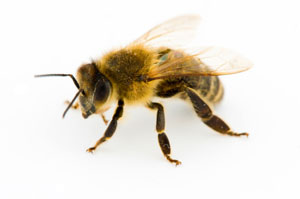
A bee
Scientists have discovered a powerful toxin in bee venom that could end up playing a crucial role in preventing the spread of HIV.
HIV is much smaller than the nanoparticles and fits in between the bumpers. When HIV comes across a nanoparticle it goes in between the bumpers and comes into direct contact with its surface, which is coated with the bee toxin, which destroys it.

Hood explained "Melittin on the nanoparticles fuses with the viral envelope. The melittin forms little pore-like attack complexes and ruptures the envelope, stripping it off the virus."

While most anti-HIV medications work on inhibiting the virus' ability to replicate, this one attacks a vital part of its structure. The problem with attacking a pathogen's ability to replicate is that it does not stop it from starting an infection. Some HIV strains have found ways to circumvent replication-inhibiting drugs, and reproduce regardless.

Hood said:

"We are attacking an inherent physical property of HIV. Theoretically, there isn't any way for the virus to adapt to that. The virus has to have a protective coat, a double-layered membrane that covers the virus."

Melittin nanoparticles may prevent and treat existing HIV infections

Hood believes that the melittin-loaded nanoparticles have the potential for two types of therapies:
  • A vaginal gel to prevent the spread of HIV infection
  • Therapy for existing HIV infections, particularly drug-resistant ones
In theory, if the nanoparticles were injected into the patient's bloodstream, they should be able to clear the blood of HIV.

Hood said "The basic particle that we are using in these experiments was developed many years ago as an artificial blood product. It didn't work very well for delivering oxygen, but it circulates safely in the body and gives us a nice platform that we can adapt to fight different kinds of infections."

Melittin attacks double-layered membranes indiscriminately, making it a potential for drug therapies beyond HIV infections. The hepatitis B and C viruses, among several others, rely on the same type of protective envelope and could be targeted and destroyed by administering melittin-loaded nanoparticles.

The gel also has the potential to target sperm, the researchers explained, making it a possible contraceptive medication. The study, however, did not look at contraception.

Hood said "We also are looking at this for couples where only one of the partners has HIV, and they want to have a baby. These particles by themselves are actually very safe for sperm, for the same reason they are safe for vaginal cells."

This study was carried out in cells in a laboratory environment. However, the nanoparticles are easy to produce - enough of them could easily be supplied for future human studies.


Recent research on HIV

Over the last few years, scientists have made strides in improving HIV/AIDS treatments and prevention strategies.

Baby "functionally cured" of HIV infection - researchers from Johns Hopkins Children's Center, the University of Mississippi Medical Center and the University of Massachusetts Medical School reported that a baby who was administered antiretroviral therapy thirty hours after being born was "functionally cured". A functional cure means that there is no detectable viral replication after retroviral therapy has stopped.

Ramping up HIV antiretroviral treatments worth the extra cost - investigators from Harvard University, USA, reported that scaling up HIV antiretroviral treatment in a remote province of South Africa (KwaZulu-Natal) reduced the risk of transmitting HIV to sexual partners by 96%.

Written by Christian Nordqvist
Copyright: Medical News Today
Not to be reproduced without the permission of Medical News Today.