Showing posts with label obesity. Show all posts

Tuesday, January 21, 2014

Obesity Possibly More Deadly than Originally Believed


Heavy burden: Obesity may be even deadlier than thought

Aug. 15, 2013 at 5:43 PM ET

Video: Researchers say obesity is responsible for many more deaths than earlier estimates -- and one gender is more susceptible to its effects than the other. NBC’s Nancy Snyderman reports.

Obesity kills far more Americans than we think it does, according to a controversial new study that suggests obesity accounts of about 18 percent of all deaths in the United States - three times previous estimates.

The research, published in the American Journal of Public Health, suggests the latest government estimates soft-pedal the dangers of obesity. And the controversy over the findings show how difficult it is to calculate the costs of being overweight.

With a third of Americans overweight and another 35 percent obese, it’s not a trivial question.

The federal government has been in hot water over the issue before. In 2004 the Centers for Disease Control and Prevention slashed its estimates of obesity-related deaths from 365,000 a year to 112,000 a year, amid a battle over how it made its calculations. And a few recent studies have shown that for people over 65, having a little extra pudge may be protective.

But Ryan Masters, who did the latest study while at the Robert Wood Johnson Foundation and Columbia University, says he’s found obesity is the cause of 20 percent of deaths among women and 15 percent of men.

“We found that obesity indeed has a quite significant effect on mortality levels in the United States and estimates are actually significantly larger than prevailing wisdom has suggested,” Masters told NBC News.

“Existing literature largely indicates roughly about 5 percent of all adult deaths in the United States could be associated with overweight or obesity,” Masters says. “What we find is that between the ages of 40 and 85 … about 18 percent of all deaths that took place between 1986 and 2006 could be said to be associated with high body mass.”
Masters thinks this may get worse. There's now a whole generation of Americans who have been obese from childhood and will be obese their whole lives. The effects on them may be much worse, he predicts.

Other experts immediately questioned the way Masters made his calculations. He used data from several national health surveys that ask people, among other things, how much they weigh and how tall they are – which in turn are used to calculate body mass index (BMI) and show whether someone is overweight or obese. The data covers 20 years, from 1986 to 2006.

Then he looked at death records for the same people. “Previous research has likely underestimated obesity’s impact on US mortality,” Masters and colleagues wrote.
“Importantly, counter to most extant research, obesity’s effect on mortality risk grows stronger with increasing age.” In 2005 and again in January, Dr. Katherine Flegal and colleagues at the National Center for Health Statistics have found that being overweight maylower your risk of death if you’re 65 or older. 

“When you look at the association between weight and mortality, the association is weak,” Flegal told NBC News – although she says younger people who are obese do have a clearly higher risk of dying early.
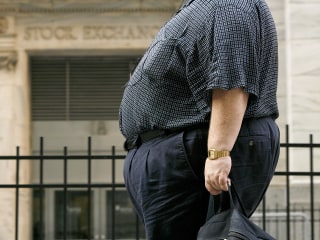
Could obesity be a bigger killer than we thought? A new study suggests so
LUCAS JACKSON / Reuters file
A new study finds obesity may cause 18 percent of recent deaths in the United States
Masters says these numbers leave out people in hospitals and nursing homes, for one thing. "From our findings, obesity actually has a very strong and substantial effect on old age mortality risk,” he says.
Why is this so hard to figure out? In part, it’s because obesity isn’t a direct cause of death. 

The CDC doesn’t list obesity as a cause of death. Instead, it lists heart disease as the No. 1 cause, killing nearly 598,000 people a year, while cancer kills 575,000. Overall, nearly 2.5 million Americans died in 2010.
People who are overweight or obese are far more likely than thinner people to have heart disease, cancer, diabetes and to have strokes or heart attacks. Usually, but not always, fatter people are less fit than thinner people, and exercise can clearly protect you from death and disease.

“They didn’t account for smoking other risk factors like alcohol consumption,” says Kenneth Thorpe, a former Health and Human Services department official who is now an expert on health policy at Emory University in Atlanta. “The study doesn’t account for health insurance status, and we know that contributes to mortality rates.”

People who are obese are more likely to smoke than people who are not, Thorpe says, and they eat more unhealthful foods.

Other studies have found that the more educated people are, the less likely they are to be obese and the more they earn the thinner they are. A third of American adults who earn less than $15,000 per year are obese, compared with about a quarter of those who earn at least $50,000 per year, the non-profit Trust for America’s Health found in its “F as in Fat” report last year. 

The group’s Jeff Levi says it’s important to distinguish between whether being fat causes death, or whether it’s just correlated with death. Either way, it’s bad. “Whatever the disagreements among researchers, we know that obesity is not good for your health,” Levi says.

This year's report finds Louisiana has passed Mississippi for the dubious distinction of being the state with the most obese people. It finds rates of adult Americans with a BMI of 40 or higher have grown in the past 30 years from 1.4 percent to 6.3 percent—a 350 percent increase.

“Even if the nation holds steady at the current rates, Baby Boomers—who are aging into obesity-related illnesses—and the rapidly rising numbers of extremely obese Americans are already translating into a cost crisis for the healthcare system and Medicare," Levi says.

Former Health and Human Services secretary and Wisconsin governor Tommy Thompson says this finding demonstrates why Medicare should pay for obesity treatments and why obesity should be classified as a separate disease. He applauds the American Medical Association’s decision to classify obesity as a disease.
“If we are going to get a handle on healthcare costs, obesity is front and center,” he said in a telephone interview.

“We simply must stop waiting for people to get sick and then spend infinitely more trying to make them well again," he added. "Covering obesity is a no-brainer, and we must begin behaving rationally if we are going to come to grips with rising health costs and a population that’s getting sicker.”

Jane Derenowski and Stacey Naggiar contributed to this report

Friday, July 19, 2013

How One Women Went From Obesity to a Beach Body


Tim Ferriss

GET UPDATES FROM TIM FERRISS

How One Woman Went From Obesity to a Bikini Body

Posted: 07/18/2013 10:51 am

2013-07-18-Image1.jpg
This post will explain exactly how Briana, a mother of three and reader of my blog, lost 100 pounds. It's a lot simpler than you might think.
For additional real-world examples and the fundamentals, I suggest reading How to Lose 100 Pounds on The Slow-Carb Diet. There are several men and women profiled.
Now, onto our post, which was written by Briana herself. I've avoided any major edits to preserve her voice.
Please add any questions or tips of your own to the comments.

Enter Briana

If you're meeting me for the first time today, you'd never guess that a little over one year ago, I was 100 pounds heavier and the furthest thing from being proud in a bikini.
And if you'd met "the FAT me" a year ago, you probably never would have guessed that the over-weight mother of three was actually an accomplished personal trainer who'd lost 73 pounds years earlier... and gained it all back.
That is really where my introduction to the Slow-Carb Diet (SCD) began.
Five years ago, I was a stay-at-home mom.
I had a husband, two kids, a house in the suburbs with a white picket fence, and a great dane. I was a young mom in my early '20s, trying to balance everything and be everything to everyone but neglecting myself. I made my family the priority, which was great for them, but I lost myself somewhere along the way. Despite numerous failed attempts to lose weight and get in shape, the scale just kept creeping up.
Fat, depressed, and frustrated, I ended up surfing the internet one day for some new nutrition and training inspiration, when I stumbled across Tim's blog and the post he wrote on How to Lose 20 lbs of Fat in 30 Days... Without Doing Any Exercise. Four paragraphs in, I was hooked! I read it, I applied it day-in and day-out, and within six months I had not only lost the 73 POUNDS I had gained after having my first two kids, but I had completely transformed my body!
Needless to say, the experience was life-changing. After it, I felt compelled to pursue a career as a certified personal trainer and nutrition specialist. I wanted to empower, educate, and inspire other women to transform their bodies and regain a renewed sense of self -- just as I had.
Shortly after I became certified, I went through a devastating divorce. As a newly single-mom, I set out to "4-Hour Workweek" my life, started my own multi-faceted health and wellness company, and spent the last five years helping to transform the bodies and lives of hundreds of women around the world in ways they never thought were possible.
Along the way, Tim wrote and released The 4-Hour Body, and my story was featured on national television and throughout numerous editorials, spreads, and fitness publications -- the biggest of which was an appearance with Tim on the Dr. Oz show.
2013-07-18-Image2.jpg

And then? I got pregnant with baby #3.
Long story short: despite being a personal trainer and all my previous hard work to be a "weight-loss success story," I ended up being one of those Mego-Prego women who really went for it! By "went for it" I mean -- if my weight gain had been an accurate barometer of my son's birth weight, I should have given birth to a kindergartner!
From the moment I first found out that I was pregnant I decided to use the "eating for two" excuse. I indulged my cravings, and I packed on the pounds by way of ice-cream, Mexican food, lasagna, and a total break from the adapted SCD nutrition principles I worked so hard to establish in my own life and subsequently teach others.
Needless to say, I exploded over nine months, and by the time I actually gave birth to my eight lb. six oz. bundle of joy, I found myself weighing the heaviest of my life-100 pounds heavier than normal.
So my baby is born... and I find myself asking, "Now what, fatty?"

TRANSFORMATION: ROUND 2

Faced with the depressing reality that the new weight wasn't "baby weight" and was reallyall me, I made it my mission to swiftly re-apply the SCD principles to shed the post-partum pounds in record time.
It began with a commitment to change, and a real look in the mirror.
So many of us are miserable over the current condition of our bodies, we get motivated and inspired by reading stories such as mine, but that's not enough. We need something lasting. Something that will motivate us to walk away from the bread basket, or in my case -- back away from the sour cream twice-baked potato!
For me, that motivation came in the form of photos.
Before I began, I committed to document the entire process via a weekly pictorial where I would stand raw, real, and exposed in front of a camera wearing nothing but the same tiny black bikini. When I felt discouraged, or was having a internal struggle over something I shouldn't eat, I would look at the photos of where indulging got me -- fat.
I took it one day and one meal at a time.
Beginning the day after I gave birth, I followed every slow-carb principle that is outlined -- except for the cheat day.
The reason? I was breast-feeding, and through trial and error, it turned out that keeping my diet consistent by eating the same thing (more or less) everyday was much better for my baby (and my sanity), than trying to sooth a horrific colicky newborn 12-24 hours after binge eating on a "cheat day."
The biggest SCD keys behind my latest post-pregnancy transformation were:
- Structuring every meal around a lean protein
- Meal frequency (eating every three hours)
- Totally avoiding refined, processed, starchy carbohydrates, and wheat (I came up with some wicked slow-carb recipe option substitutes)
- Eliminating dairy
- Completely cutting out fruit, which was my biggest craving during my pregnancy
- Drinking a gallon of water a day
- Upping my daily fish oil to one gram per one percent body fat -- liquid form. Obviously, that'd otherwise be quite a few pills.
Just with the slow-carb diet alone and zero exercise (due to some postpartum recovery issues between week one and week eight), I lost 36 POUNDS.

(Click here for larger image)
2013-07-18-Image3.jpg
And 12 months after giving birth, I hit my goal and lost 100 pounds (23 pounds of which were pre-pregnancy), and completely transformed my body.
2013-07-18-Image4.jpg
2013-07-18-Image6.jpg

Consistency is key. A typical day on the SCD might look like this:
Breakfast @ 7 a.m.
Egg white frittatas (made with veggies like mushrooms, bell pepper, and onion)
Snack @ 10
Veggies with hummus
Lunch @ 11:30
Usually dinner leftovers from the night before (i.e. Bison marinara sauce over zucchini spaghetti; Tuna stuffed avocados; etc.)
Snack @ 2
Small mixed green salad with chicken, cucumbers, green peppers, and tomatoes with a homemade lemon/garlic vinaigrette
Dinner @ 6
Tilapia fillet served over broiled garlic carrots, and coconut "rice" (cauliflower)
Biggest tip: If you fail to plan, you're planning to fail
As a mom, life can be hectic, and it rarely goes according to plan.
I always prepare ahead of time for those moments with some quick-grab protein snacks. Turkey wrap "roll-ups" with a little hummus and a sliver of bell pepper or cucumber inside is my fave! Or little snack-sized baggies of almonds sprinkled with cinnamon. Hard-boiled "hummus deviled eggs" is another.
Prepare or fail, the choice is yours.

Conclusion

Putting on a bikini seven days after you give birth is uncomfortable. Some might argue it's insane.
Standing in front of the bright lights of a professional photographer week-after-week (often times without seeing much change), especially when you're a personal trainer who is 100 pounds over weight, is humiliating, humbling, and painful.
But transforming my body, documenting the journey, inspiring other mothers, and ultimately founding BikiniBodyMommy.com has been the most empowering 12-month process I've ever undergone.
The journey isn't always easy, but nothing worthwhile ever is.
My name is Briana. I am a 31-year-old mother of three, I've lost more than 100 pounds onthe Slow-Carb Diet, and I work every day to be a success story.
2013-07-18-Image5.jpg